Question, guess, build, test: hands-on science at home
A simple cycle for science and building challenges at home, with questions that help children explain their thinking and learn from a test that does not work.
Why this matters
Young children are natural scientists. They push, pour, stack and ask “why” all day. Hands-on challenges turn that curiosity into a habit of thinking: ask a question, make a guess, try it, look at what happened, and improve.
You do not need a lab. Paper, tape, cups, water and seeds are plenty.
The cycle
- Ask a question. “Which paper bridge can hold more coins?”
- Guess, with a reason. “I think the folded one, because it is thicker.”
- Build or set up a fair test. Change one thing only.
- Test and look closely. Count, measure, draw or take a photo.
- Explain. “What happened? Why do you think so?”
- Make it better. “What would you change next time?”
Questions that help children think out loud
- “Can you say more about what you mean?”
- “What makes you think so?”
- “What did you expect, what happened, and what might explain it?”
- “What happened that you did not expect?”
Try simple family rules for talking about ideas: listen, say if you agree or disagree, give a reason, and ask for a reason.
What the research says
Guidance from the Education Endowment Foundation finds that teaching children to plan, monitor and evaluate their work supports learning (source 1). The question, test and improve cycle gives natural practice in all three.
Science educators at the Smithsonian describe practical ways to teach young children (sources 2 to 6). Start from something real that puzzles them. Turn their questions into ones they can test. Use sentence starters such as “I think this because.” Let them work toward a shared goal. Use real objects first, then screens to explore further. Offer several ways to show what they know, such as speaking, drawing or building. One paper gives a clear sign of progress: a child points to what they saw as the reason for an idea, instead of saying “they all look the same” or “I just think so.”
Harvard researchers who studied thinking habits found that noticing when a problem needs thinking matters a great deal (source 7). A test that surprises a child is a perfect moment to notice.
What the research does not say
- Most of the science papers describe teaching approaches. They are not experiments that prove these steps raise scores.
- Finishing a challenge shows taking part. It is not proof of scientific mastery.
- The thinking-habits studies were small and with older students.
Keep it safe and simple
- Choose activities with everyday materials.
- Keep small items, such as coins, away from younger siblings.
- Wash hands after working with soil, seeds or leaves.
- Let surprising results stand. A “wrong” result is still a real result.
Make room for every child
Some children prefer to draw what happened. Others want to talk, build again, or take a photo. All of these count. Short, hands-on steps work well for children who need to move.
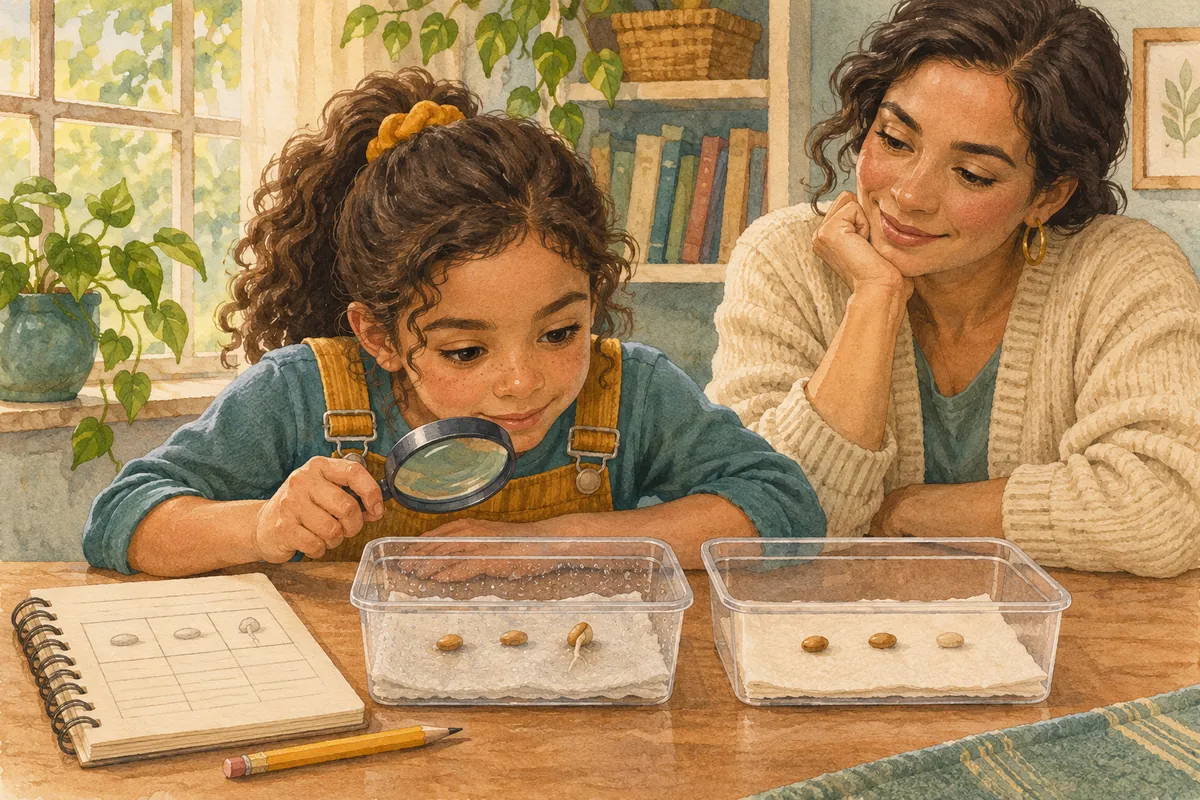
Keep a simple science notebook
A notebook makes thinking visible. On each page, your child can write or draw the question, the guess, a picture of the setup, and what happened. Later, flip back through the pages together. Children are often proud to see how their ideas changed over time.
Try it this week
Fold two strips of paper into different bridge shapes. Lay each across two books. Guess which will hold more coins, and why. Test both, adding coins one at a time. Then ask, “What would make the weaker one stronger?” and try it.
Try it with your child
Sources and how far they apply
- Metacognition and Self-Regulated Learning: Guidance Report (Education Endowment Foundation (Quigley, Muijs and Stringer), 2018). Mostly UK school evidence. It supports teaching planning and self-checking; it does not test any particular app or routine at home.
- Nurturing Young Thinkers: How science can enhance early elementary students' curiosity and communication skills (white paper) (Sarah J. Glassman, Smithsonian Science Education Center, on the Carolina Biological Supply site, 2021). A publisher’s paper for early elementary teachers, not an experiment.
- Building Thinkers through Science (white paper) (Smithsonian Science Education Center, on the Carolina Biological Supply site, no date shown on the page). A publisher’s paper about its own program, not an experiment.
- Thinking Like an Engineer: How all elementary students can learn to solve problems like an engineer (white paper) (Theresa Green (National Science Foundation intern), Smithsonian Science Education Center, on the Carolina Biological Supply site, 2021). A short paper built on other authors, not an experiment.
- Focus on the Stuff: When you combine digital tools with hands-on activities, learning sticks (white paper) (Smithsonian Science Education Center (interview with its director, Carol O'Donnell), 2022). An interview with the program’s own director, not an experiment.
- Teaching Everyone: Addressing Diversity, Equity, Accessibility, and Inclusion in the STEM Classroom (white paper) (Smithsonian Science Education Center, on the Carolina Biological Supply site, no date shown). A publisher’s paper that relies on other authors, not an experiment.
- Intelligence in the Wild: A Dispositional View of Intellectual Traits (Perkins, Tishman, Ritchhart, Donis and Andrade, Harvard Graduate School of Education (Educational Psychology Review, 2000). A 25-year-old review by the researchers about their own approach. Their studies were small and with older students.
Sources were checked when this article was written. This article is general education, not medical, diagnostic or legal advice.
Coming soon: MySoarBoard
The Foundation is building a home–school learning board for children in kindergarten through grade 3 that puts ideas like this into daily practice. See what is inside or request an early peek (opens the Foundation's website).